Suckled by She-Wolves
The Mothers, Mistresses, and Working Women at Rome's Foundation

Brutus in Love was a screenplay I finished a few years back that got some positive traction on the Blacklist and survived the first round of the Nichols Fellowship. I’m proud of it even though it will probably never be produced, because I managed to accomplish three things: a surrealist retelling of one of history’s most famous assassinations; a swap of the grand battle scenes associated with “epics” for the bloody, claustrophobic urban warfare that was really just an extension of Roman electoral politics; and three-dimensional characters drawn from the women of the period.
The original title was She-Wolves — an allusion to the power and influence that the wives, daughters, and mothers of the age had over figures like Pompey the Great, Julius Caesar, and Marcus Junius Brutus.
For all their martial prowess and masculine bravado, Roman men — especially in aristocratic circles — were mama’s boys. No cap. I say this as a proud mama’s boy who is fairly certain he’s raising another one. Women were often at the nexus of power in ancient Rome, wielding influence behind the scenes through the men in their family while directly controlling vast wealth: agricultural estates, city real estate, silver and gold mines worked by enslaved labor. Coriolanus — the semi-legendary figure from Rome’s early Republic, immortalized by Shakespeare — is said to have halted his attack on an ungrateful Rome when his mother and wife came out to plead with him. By acquiescing to them, he was most likely assassinated by the very army he had promised to lead to victory.
Most importantly, Roman women were on the front lines of battles that raged inside Rome while the men fought far from home.
In honor of Mother’s Day, I’m highlighting some of the most important mothers in Ancient Rome: Cornelia, mother of the Gracchi; Atia, mother of Augustus; Aurelia, mother of Julius Caesar; Servilia, mother of Brutus; Livia, wife of Augustus and mother of Emperor Tiberius — and a final detour to the city’s own founding mother, the she-wolf.
Cornelia (c. 190–100 BC) — Mother of the Gracchi
If Rome had a patron saint of motherhood, it would be Cornelia. Daughter of Scipio Africanus — the general who defeated Hannibal and saved the Republic — she married well, bore twelve children, and watched nine of them die before adulthood. When a Roman noblewoman once showed off her jewelry and asked Cornelia to display hers in return, Cornelia gestured to her two surviving sons and said: “These are my jewels.” The line is almost too perfect, which is probably why Rome repeated it for centuries.
But Cornelia wasn’t just a symbol. She was an operator. After her husband’s death she refused a marriage offer from the King of Egypt, stayed a widow, and poured everything into her sons’ education — hiring the best Greek scholars in the Mediterranean world to teach them philosophy and rhetoric. It worked. Tiberius and Gaius Gracchus became the most consequential reformers of the late Republic, fighting for land redistribution and the rights of Rome’s poor. Both were eventually killed by the aristocratic establishment they threatened.
Rome later erected a bronze statue of Cornelia in the Forum — the first public statue of a Roman woman in the city’s history. The inscription read simply: Cornelia, Mother of the Gracchi. Not wife of. Not daughter of. Mother of.
Atia (c. 85–43 BC) — Mother of Augustus
Atia doesn’t get nearly enough credit for what she built. The niece of Julius Caesar, she was widowed when Octavian was four years old and spent the next two decades quietly engineering the career of a boy the world would eventually call Augustus — the first emperor of Rome and one of the most consequential rulers in human history.
Tacitus described her as one of the most admired matrons in the history of the Republic: devout, disciplined, demanding. She oversaw Octavian’s education with the kind of focused intensity that Caesar himself apparently noticed — it was Atia’s upbringing, by most accounts, that convinced Caesar to name her son his heir. When Octavian moved to enter politics after Caesar’s assassination, Atia reportedly tried to talk him out of it. She understood better than anyone what that world cost.
She died in 43 BC, during her son’s first consulship, before she could see what he became. Augustus gave her a public funeral — an honor almost unheard of for a woman. The dynasty she helped create lasted two hundred years.
Aurelia Cotta (c. 120–54 BC) — Mother of Julius Caesar
Tacitus grouped Aurelia with Cornelia and Atia as the three exemplary Roman mothers who shaped the Republic’s most consequential sons. Plutarch described her as possessing discretion, intelligence, beauty, and uncommon sense. A Roman tribe — the Aurelia — was named in her honor, a rare public acknowledgment of a woman’s standing.
Her influence on Caesar went well beyond tutors and household management. She was the kind of mother who read the room and acted. When the Bona Dea festival — a sacred women’s rite held at Caesar’s house — was infiltrated by the politician Publius Clodius Pulcher disguised as a woman, reportedly to pursue an affair with Caesar’s wife Pompeia, it was Aurelia who uncovered the intrusion and testified against him at trial. Caesar divorced Pompeia over the incident with the line that has echoed through history: “Caesar’s wife, like all Caesar’s family, must be above suspicion.” That line has Aurelia’s fingerprints on it.
She died in 54 BC, a decade before her son’s assassination. Caesar, by then the most powerful man in the Mediterranean world, interrupted his campaigns to return to Rome for her funeral.
Servilia (c. 100–23 BC) — Mother of Brutus
Servilia is a central figure in She-Wolves. My original instinct was to make her the protagonist: following her from early childhood at the feet of her uncle, the reformer Marcus Livius Drusus, through her thirty-year affair with Julius Caesar, to the moment her son assassinates her lover — and then to her machinations behind the scenes ensuring Brutus had the money to prosecute a war against his killer. After Brutus’s death, Servilia steps out of the shadow entirely, personally leading a protest of widows facing taxation for the first time at the hands of Octavian.
I ultimately pulled back. As formidable as she was, her agency was still largely exercised through the men in her family, and the screenplay’s most dramatic scenes took place in male-only environments where Servilia could only watch.
My favorite line in the script comes from a conversation between Servilia and Brutus. She implores her son — obsessed with Stoic philosophy after his uncle Cato’s death — not to smell like a philosopher. When he asks what a philosopher smells like, she acidly responds: “Poverty and feet.”
That sharpness was real. Servilia was known for her wit and her political instincts. Her first husband, Brutus the Elder, was a descendant of the man who founded the Roman Republic and a firm ally of the populist faction led by Julius Caesar’s uncle Marius. In Rome’s small, incestuous aristocracy, this connection would have put the young Caesar in Servilia’s orbit early. She almost certainly helped shape him — and then spent thirty years as his most intimate confidante, her wealth and influence quietly advancing the careers of the men around her.
Through her relationship with Caesar — which prompted him to pardon Brutus after Pharsalus and lavish gifts on her, including a pearl worth six million sesterces — Servilia exerted subtle but significant influence over the late Republic’s most consequential events.
At its core, hers is a love story. The affair with Caesar makes for great entertainment, but it was her love for Brutus that defined her. She spent everything she had to keep him alive. She outlived him anyway.
Livia Drusilla (59 BC–29 AD) — Mother of Emperor Tiberius
Lucille Bluth from Arrested Development is one of my favorite TV moms — a role played to perfection by the late, great Jessica Walter. She also voiced Mallory Archer in Archer: a force of nature at the offices of her family business and in her home, with her children perpetually reacting to her machinations. That engine — maternal ambition as the chaos at the center of everything — is the closest modern shorthand I have for Livia Drusilla.
A weaker person dealt Livia’s hand would have folded. Being born into one of Rome’s richest and most noble families sounds like good fortune in any era, but during the political decay between the late Republic and the Empire, aristocratic blood was as often a death sentence as a privilege. Livia spent her young adult life on the losing side of nearly every conflict. As Octavian and Antony culled the aristocracy in revenge for Caesar’s murder, Livia, her husband, and their infant son dodged death repeatedly — including barely escaping a burning forest alive, her dress still smoking when she emerged.
She met Octavian when she was pregnant with her second child, after her husband reconciled with him following Antony’s defeat. Octavian was immediately captivated — Livia had the one thing he lacked: genuine ancestry. His mother’s family traced back to Caesar, but his father’s people were new-money Italians who had bought their way into Rome’s elite. Livia recognized his intelligence and ruthlessness in equal measure. On the same day she gave birth to her second son, she divorced her husband. She moved into Octavian’s house and married him shortly after.
What followed was one of the great political partnerships in Roman history. Livia became Augustus’s closest confidante, advising him on governance while spending the next four decades engineering her son Tiberius’s path to the throne — whether Tiberius wanted it or not. Later Roman historians accused her of ruthlessness, even of eliminating rivals who stood between Tiberius and succession. The Senate, at Augustus’s death, wanted to name her Mater Patriae — Mother of the Fatherland. Tiberius blocked it.
Tacitus’s verdict on her death is one of the most devastating lines in Roman historiography: once she was gone, he wrote, Tiberius’s reign collapsed into tyranny. She had been the restraint. She had been the political intelligence. She had been, in the truest sense, the power behind the empire.
The She-Wolf and Rome’s Founding (c. 770 BC)
Lupa: Mother, Monster, Metaphor
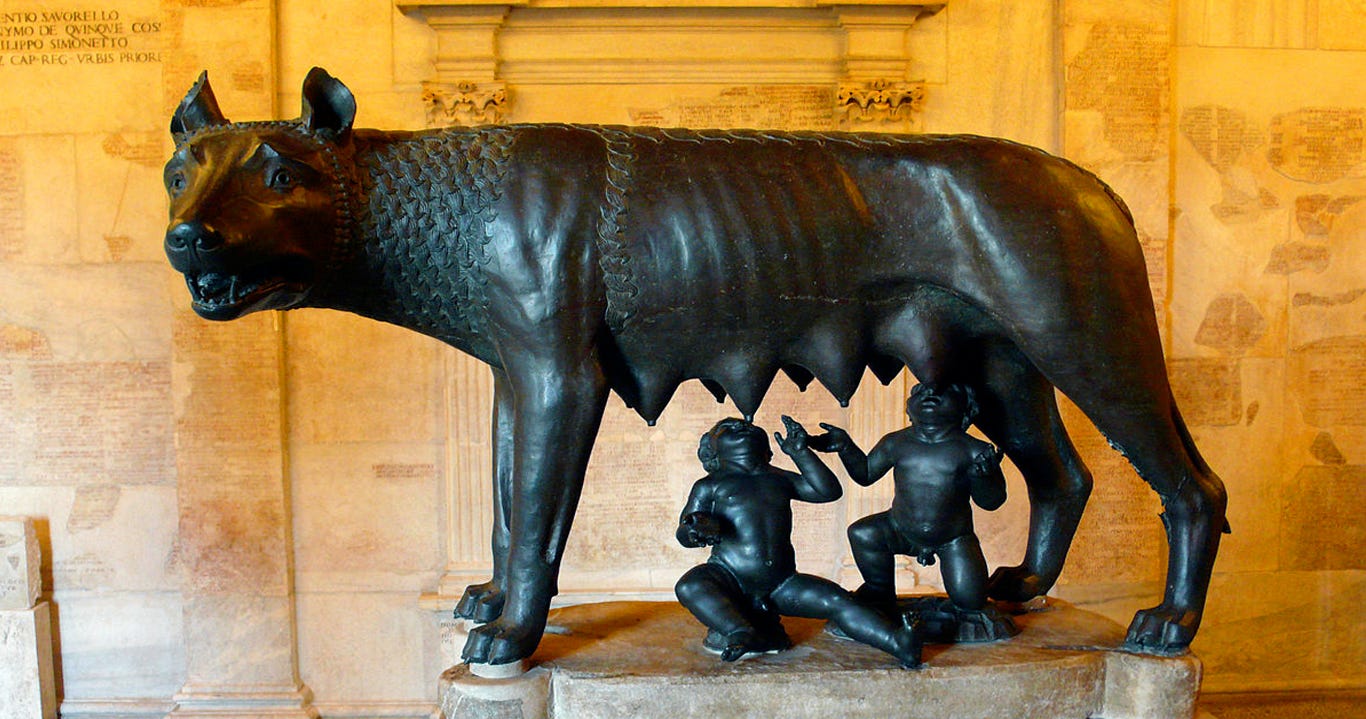
In the Roman foundation myth, the She-Wolf (lupa) nursed and sheltered the twins Romulus and Remus after they were abandoned on the banks of the Tiber. She cared for them in her den — a cave known as the Lupercal, at the foot of the Palatine Hill — until the shepherd Faustulus found them and brought them home.
But lupa carried a double meaning every Roman understood. In Latin, the word could describe a she-wolf or a prostitute — a ferocious animal or a woman of voracious appetites. The paradox was baked into the myth from the beginning.
The site of what would eventually become Rome was a natural trading center where goods from city-states along the Mediterranean could be unloaded and moved into the rest of Italy. With traders came the world’s oldest profession. The prostitutes of early Rome were known to be aggressive — howling at potential clients to beckon them in. The word for that howling creature was already in the language. The truth of Rome’s founding was hiding in plain sight, wrapped in the fur of a fantastical myth.
Livy acknowledged it directly. The shepherd’s wife who actually raised Romulus and Remus — Acca Larentia — had reportedly earned the nickname lupa from the local shepherds because she was, in Livy’s careful phrasing, “free with her favours.” The wolf, in other words, may have been a woman. The founding act of Roman civilization — the nursing of its future kings — may have been performed by a sex worker.
Rome didn’t erase her for it. Rome built temples for her. The festival of the Larentalia, celebrated every December 23rd, honored Acca Larentia as a goddess of fertility and the earth. She left her fortune, according to legend, to the Roman people.
In a warrior aristocracy like Rome’s, fathers were frequently absent — on campaign, in exile, or dead. Aristocratic women survived through the success of their sons and worked hard to advance them, deploying their own wealth, networks, and nerve. The women in this piece weren’t operating at the margins of Roman power. They were at its center — often more consequential than the men whose names filled the histories.
Rome was built by its mothers. Some of them were saints. Some were operators. One, if the legend is right, was a she-wolf.
Happy Mother’s Day.
📚 Imperial Reading Shelf
Lives (Brutus, Cato, Gracchi, Caesar) — Plutarch
The Twelve Caesars — Suetonius (on Atia and Aurelia)
Servilia and Her Family — Susan Treggiari
Ab Urbe Condita, Book I — Livy
The Roman Mother — Suzanne Dixon
She-Wolf: The Story of a Roman Icon — Cristina Mazzoni
Women and Politics in Ancient Rome — Richard Bauman